


 Cart
Cart
 sales@molnova.com


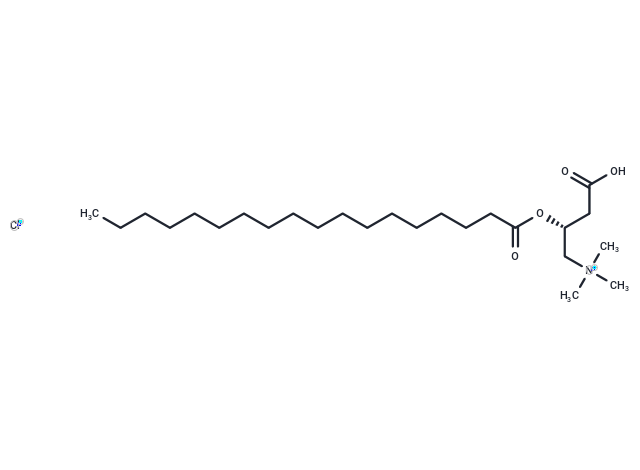
Stearoyl-L-carnitine chloride
CAS No. 32350-57-5
Stearoyl-L-carnitine chloride( —— )
Catalog No. M34977 CAS No. 32350-57-5
Stearoyl-L-carnitine chloride (Acylcarnitine C18:0) is a long-chain acylcarnitine found in the cerebellum that inhibits GlyT2 and is an important component in the study of lipid metabolism.
Purity : >98% (HPLC)
 COA
Datasheet
HNMR
HPLC
MSDS
Handing Instructions
COA
Datasheet
HNMR
HPLC
MSDS
Handing Instructions
| Size | Price / USD | Stock | Quantity |
| 500MG | Get Quote | Get Quote |


|
| 1G | Get Quote | Get Quote |
|
Biological Information
-
Product NameStearoyl-L-carnitine chloride
-
NoteResearch use only, not for human use.
-
Brief DescriptionStearoyl-L-carnitine chloride (Acylcarnitine C18:0) is a long-chain acylcarnitine found in the cerebellum that inhibits GlyT2 and is an important component in the study of lipid metabolism.
-
DescriptionStearoyl-L-carnitine chloride is an endogenous long-chain acylcarnitine. Stearoyl-L-carnitine chloride is a less potent inhibitor of GlyT2. Stearoyl-L-carnitine chloride inhibits glycine responses by 16.8% at concentrations up 3 μM.
-
In VitroStearoyl-L-carnitine (0.01-10 μM) inhibits glycine (30 μM) transports by 16.8% at concentrations up 3 μM in Xenopus laevis oocytes.Stearoyl-L-carnitine (500 μM; 30 min) inhibits Na+-dependent [3H]carnitine (20 nM) uptake by ~50% in HPCT cells.
-
In VivoStearoyl-L-carnitine is significantly decreased in Alzheimer's disease (AD), mild cognitive impairment (MCI) and subjective memory complaint (SMC).
-
Synonyms——
-
PathwayOthers
-
TargetOther Targets
-
RecptorOthers
-
Research Area——
-
Indication——
Chemical Information
-
CAS Number32350-57-5
-
Formula Weight464.12
-
Molecular FormulaC25H50ClNO4
-
Purity>98% (HPLC)
-
Solubility——
-
SMILES[Cl-].CCCCCCCCCCCCCCCCCC(=O)O[C@H](CC(O)=O)C[N+](C)(C)C
-
Chemical Name——
Shipping & Storage Information
-
Storage(-20℃)
-
ShippingWith Ice Pack
-
Stability≥ 2 years
Reference
1. Cristofano A, et, al. Serum Levels of Acyl-Carnitines along the Continuum from Normal to Alzheimer's Dementia. PLoS One. 2016 May 19;11(5):e0155694.?
molnova catalog



related products
-
NU 9056
NU 9056 is an effective and selective inhibitor of KAT5 histone acetyltransferase with an IC50 of 2 μM. NU 9056 blocks DNA damage response and inhibits protein acetylation in prostate cancer cell lines.
-
Benzyladenine
6-Benzylaminopurine, benzyl adenine or BAP is a first-generation synthetic cytokinin that elicits plant growth and development responses, setting blossoms and stimulating fruit richness by stimulating cell division.
-
Coppersensor 1
Coppersensor 1 is a boron dipyrromethene-based fluorescent sensor for selective and sensitive detection of copper(I) ions (Cu + ) in biological samples. Coppersensor 1 can be imaged using any type of fluorescence microscope, including epifluorescence, confocal and multiphoton.
